Hail bruise vs leaf spot: reading a soybean canopy after a storm
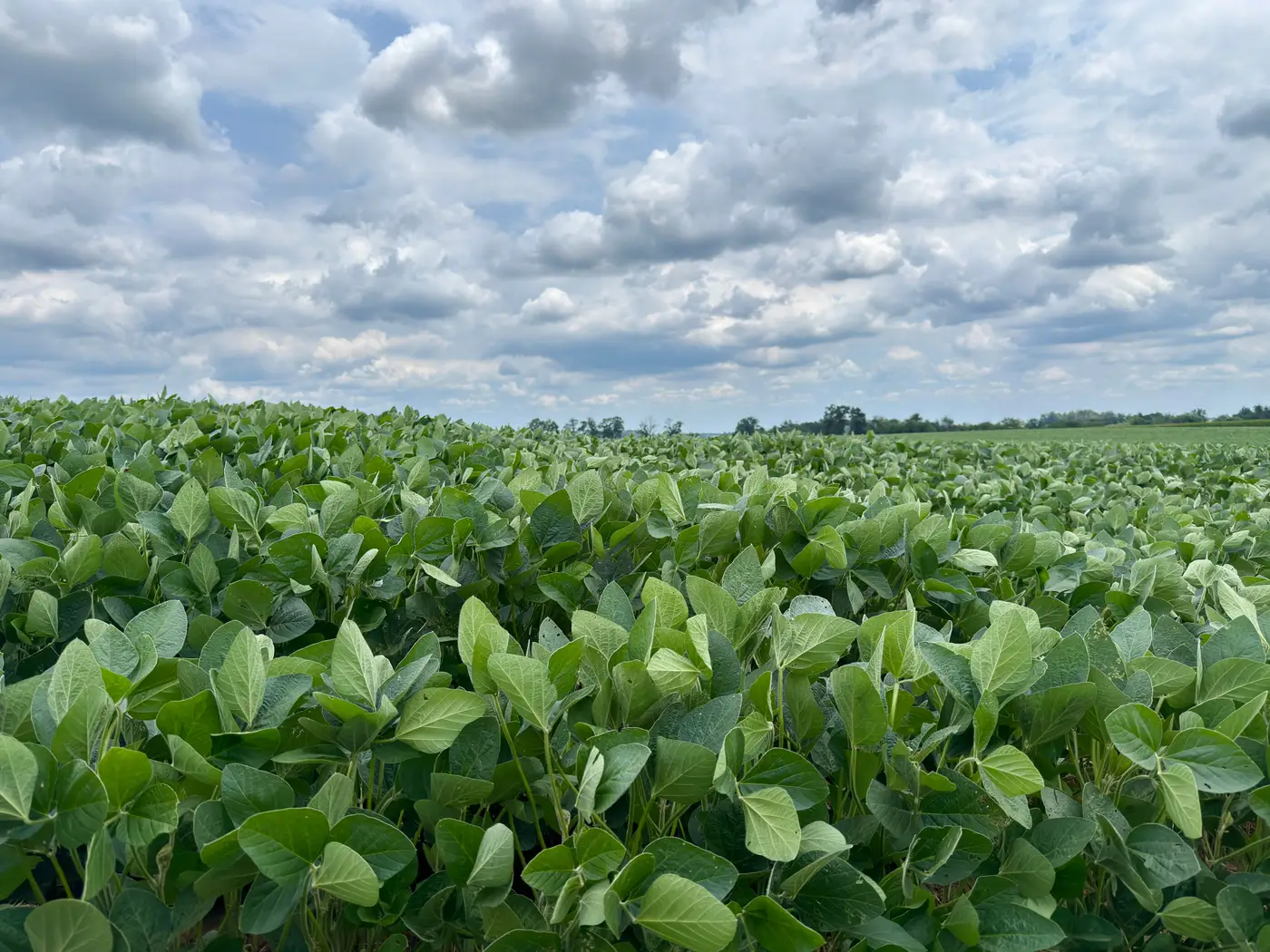
A few days after a hailstorm you walk a soybean field and see stippled, torn leaves and some scarring on the stems. The question you need answered before you write anything down: is this hail, or is it a leaf spot disease that was already moving through the canopy before the storm ever hit? Mixing the two up on a claim file is an easy way to overstate or understate severity, and in a field with real disease pressure, the two will often sit right on top of each other.
Start at the stem, not the leaf
In soybean, hail leaves its clearest signature on the stem and petiole, not the leaf blade. Look for bruising, sunken or discolored patches, on one side of the stem, usually the side that faced the storm. Disease lesions (frogeye leaf spot, Septoria brown spot, bacterial blight) almost never scar the stem in that one-sided pattern. If you're finding lesions scattered across stems and leaves alike with no consistent orientation, that's disease, not hail.
Stem bruising from hail also tends to run in short, straight scars, sometimes with a visible hole or torn epidermis where the stone actually struck. Disease cankers build more slowly and have a diffuse, water-soaked or necrotic margin rather than a clean mechanical tear.
Reading the leaf pattern
On the leaf, hail punches through or shreds tissue in a pattern tied to exposure. The upper canopy and the storm-facing side of the plant take more damage than leaves tucked underneath or on the lee side. Disease doesn't care which way the wind was blowing. Frogeye leaf spot shows circular spots with a reddish-brown border and tan center, spread fairly evenly across the plant. Septoria brown spot starts on the lower, older leaves and works upward over the season. If your damage is heaviest low in the canopy and lighter at the top, you're likely looking at something that was established before the storm, not caused by it.
Shape is the other tell. Hail tears are irregular, often with ragged edges and missing tissue, sometimes punched clean through the leaf. A lesion has a defined margin and a consistent shape repeated across many leaves, because nothing tore to make it. Hold a few leaves up to the light: a hailstone injury shows a ragged hole or a collapsed, bruised patch with irregular edges, while a lesion shows a round or angular spot with a clean boundary.
Timing is the tiebreaker
If you know the event date, that's the fastest way to settle the call. Hail injury on stem and petiole usually darkens and becomes visible within two to four days of the storm. Disease lesions, especially bacterial blight or frogeye, have typically been building for a week or more before you're standing in the row, so they show a more advanced lesion stage than a bruise that's only a few days old. If the field was already carrying visible disease pressure before the event date on your claim, expect to find both: hail scarring layered over an existing disease pattern. Separating the two means checking whether the damage lines up with the actual event date, not just cataloging whatever's present in the canopy that week.
A field walk sorts this out fine once you're standing in the row with fresh damage and a known date to check against. It's harder on a parcel you haven't walked yet, where you're deciding where to send an adjuster before anyone's boots are in the mud. That's the gap a damage boundary built from VHR imagery before the field walk is meant to close, flagging where the event hit the canopy so the first pass isn't spent sorting hail scars from a disease year on acres that may not even sit inside the affected area.
If you're grading a soybean claim where hail and a canopy disease are tangled together in the same field, start with the stem, not the leaf, and check whatever pattern you find against the event date before you write it up.
Ready to see what a damage boundary looks like on your next hail claim? Crop Loss Adjust builds it from the parcel and event date you send over.