How to document frost damage for a crop insurance claim
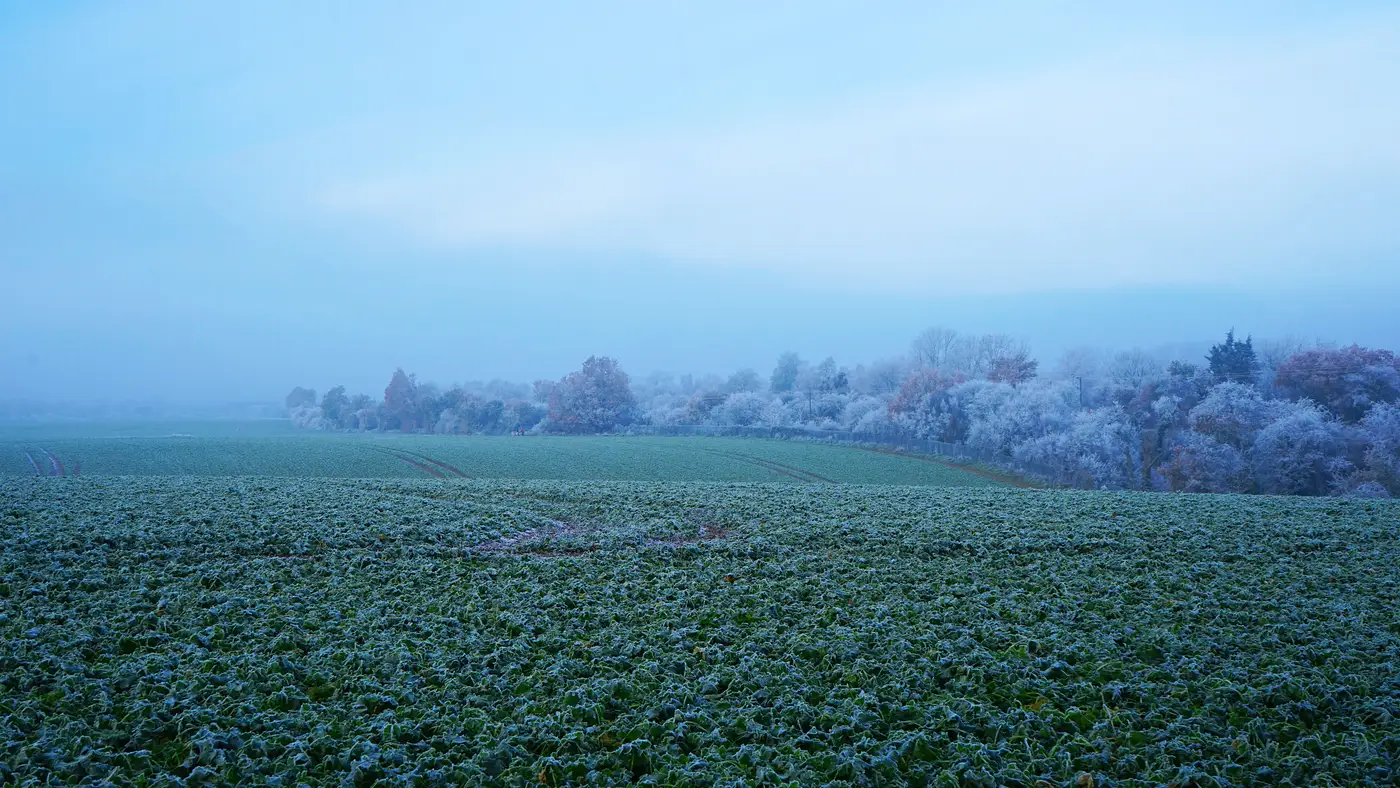
Frost claims fall apart more often than hail claims for one reason: the damage doesn't announce itself. A hailed field looks hailed. A frosted field can look fine from the truck window and dead at the growing point. If your file doesn't show the work you did to find that out, it's going to get questioned.
What needs to be in the file, and when to get it, is laid out below.
Shoot the damage before it heals or hides
Frost injury changes fast. Leaf tissue that's water-soaked and gray on day one can dry down and look like ordinary leaf burn by day four, and a plant that's dead at the crown can keep pushing a few green leaves for a week before it finally gives up. If you wait to photograph until the field "shows" damage the way a hailed field does, you'll miss the window that proves the loss.
Get out within 24 to 48 hours of the event if you can, then go back on a 5 to 7 day cycle to document how the stand responds. For each photo set:
- Shoot wide to show the stand, then close on individual plants split at the crown or growing point.
- Include something for scale, a tape measure or a marked stake, not just a hand.
- Note the row and approximate distance from a fixed point like a field entrance or pivot tower, so the photo can be tied back to a spot on the map later.
- Photograph the low ground and the high ground separately. Cold air drains downhill and pools in draws, sloughs, and the low corners of a field, so frost damage is almost never uniform across a parcel the way a uniform disease pressure would be.
Frost damage claim photos that get accepted without a fight are the ones that show a clear progression over time and tie each shot to a location, not a folder of pretty crop pictures taken whenever the adjuster happened to be in the truck.
Growth stage decides what "damage" even means
Frost injury at V2 corn and frost injury at VT corn are two different claims. A young plant with its growing point still below the soil surface can lose every leaf to frost and still come back from the crown. A plant past V6, with the growing point above ground, doesn't have that option. Wheat behaves the same way: a hard freeze at tillering is a different animal than a freeze at boot stage, when the head itself can be killed inside the stem.
Every field note needs two growth-stage entries: the stage at the time of the event, and the stage on the day you walked it. If the field was at V5 on the freeze date and you're walking it two weeks later at V8, the note has to say both, because the adjustment hinges on what stage was vulnerable when the cold hit.
The split-stalk test is still the backbone of a frost file. Split the stalk or dig the crown, check for the discoloration and softness that mean the growing point died, and write down the ratio: how many of your sample stalks showed a dead growing point versus how many were still white and firm. Do this across the field, not just in the spot that looks worst, because a frost pocket in one corner can pull the average down in a way that a single sample point won't show.
What a good field note looks like
A field note that holds up reads less like a diary entry and more like a lab record: date and time of the event, low temperature and duration if you have it from a nearby station, growth stage at the time of freeze, sample size and split-stalk ratio for each zone you checked, and a rough sketch or GPS points marking where the damage got worse or better. If the adjuster who reviews the file six months later can't reconstruct your walk from the notes, the notes didn't do their job.
The hardest part of a frost claim is drawing the line around where the damage sits inside the parcel before you've walked every acre of it. Crop Loss Adjust delivers a delineated damage boundary and severity grade from VHR imagery tied to your event date, so you know where to put your boots before you start splitting stalks.
If you've got a frost event on the books and a parcel to cover, see what a boundary ahead of the walk looks like for your claim.